PlayerRX for Clubs
One system for every team's player development.
Your club charges families thousands a year and promises development. Right now, whether that promise gets kept depends on which coach a player draws. PlayerRX puts every team on one system, so the development is on the record, on every pitch, for every player.
01 · Renewal night
“What exactly did the club do for her this year?”
March. Registration renewal week. A dad sits across from you with this year's invoice on his phone. $3,800.
“I'm not being difficult. I just want to understand what she got for it. Not the games, I was at the games. What did the club actually do to develop her this year?”
You believe in your club. So you talk about the methodology, the training ratio, the philosophy. He nods, and then he says the thing you'll be hearing in your head all spring:
“Right, but I'm asking about my daughter.”
And you have nothing with her name on it. Not a plan, not a record, not one document that proves anyone in your building thought specifically about her development this season. He's not renewing. And the three families he carpools with are about to hear exactly why.
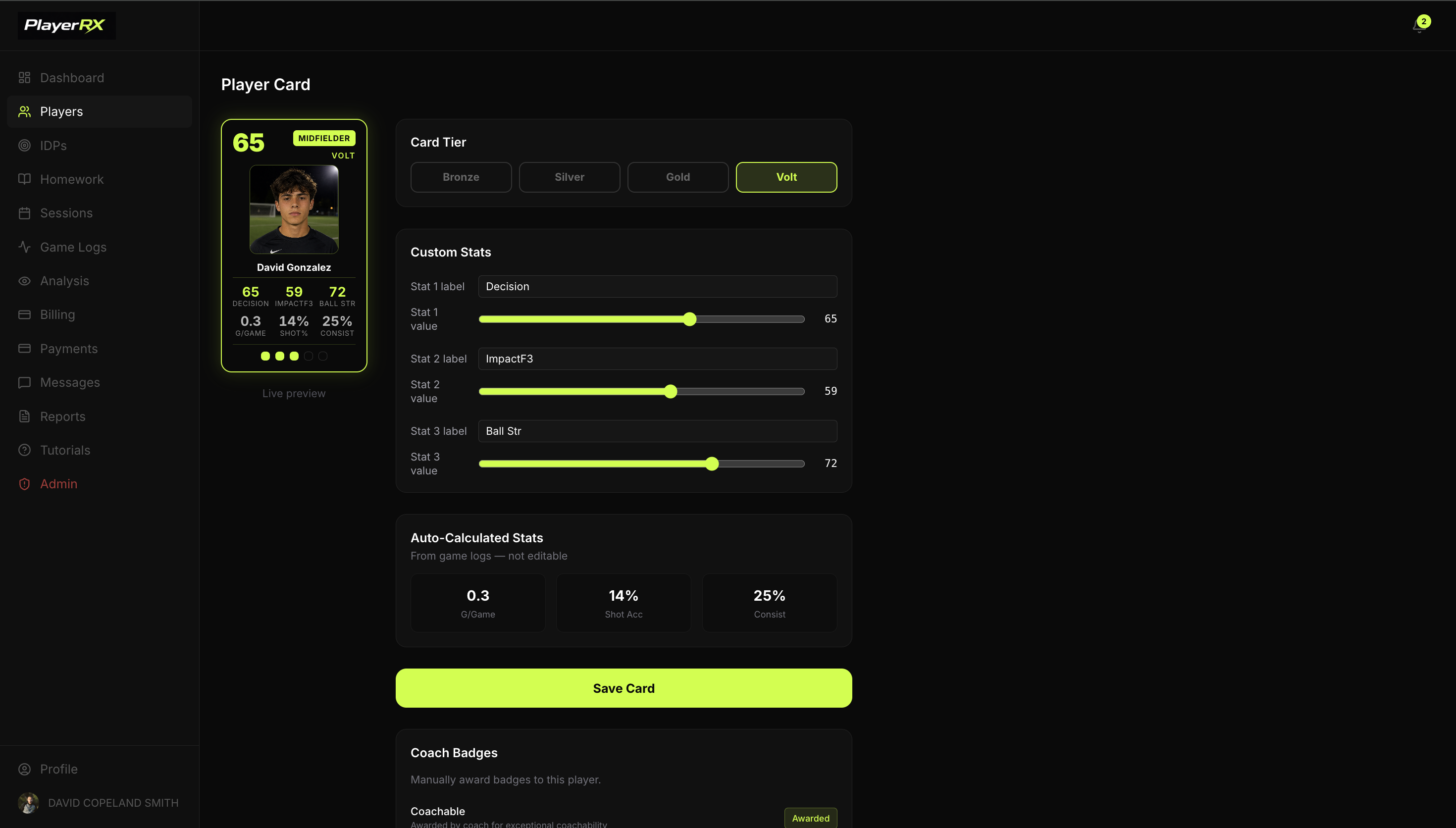
The answer, next March. One player, one record, with her name on it.
02 · The coach lottery
Your development model is real. It reaches players by luck.
Walk your own club honestly.
One coach does proper IDPs. Another stopped after preseason. Your U14 coach writes detailed feedback; your U15 coach talks about effort and calls it development. One age group has organized reports. Another has a WhatsApp group and vibes.
Every family pays the same fees. What their kid gets depends entirely on the draw. And you find out what happens on each team the same way you find out everything: when a parent complains.
Then your best coach leaves in June, taking three years of player knowledge in his head and his Notes app, and every one of his players starts from zero in August.
You can't fix this with another coaching education evening. Habits don't standardize. Systems do.
03 · The title
Your title is Director of Coaching. Directing what, exactly?
You are accountable for development across the club. The board expects it. The families are paying for it. Your title literally claims it.
And your instruments for knowing whether it's happening are: watching some sessions, trusting your coaches, and reading the room at the annual survey. If the board asked you tomorrow to prove the club developed its players this year, what would you show them? Win percentages? A curriculum PDF?
Registration has a system of record. Payments have one. Scheduling has one. The single thing that justifies your fees runs on memory and good intentions.
The instrument.
You already have tools for scheduling and messaging. What no club has is a consistent, visible development record for every player on every team. That's what this is:
Create teams, assign coaches
The club admin builds the structure. Teams, coaches, rosters. Owner and club admins see across everything. Team coaches run their own squads. Assistant coaches are read-only. Nobody edits what they shouldn't; nobody flies blind.
An IDP for every player
Player-written goals, coach-built target areas, measurement criteria, reviews. Not just the top team. The U11 third team gets the same structure your showcase team gets, which is precisely the thing no other club in your market can say.
Consistent records across age groups
Session summaries, game logs, and progress reports follow the same structure on every team. A U11 record reads the same way a U17 record does. That's what a standard is.
Development you can actually see
Look across teams and see which players are progressing, which coaches are documenting, and where the standard is slipping. Not to police coaches. To actually know.
The record stays with the club
Coaches move on; the records don't leave in their notebook. A player moves up an age group; the history moves with her, and the new coach starts with two years of context instead of a handshake.
Your brand on it
Workspace branding. To your families it reads as your club's development system, because it is.
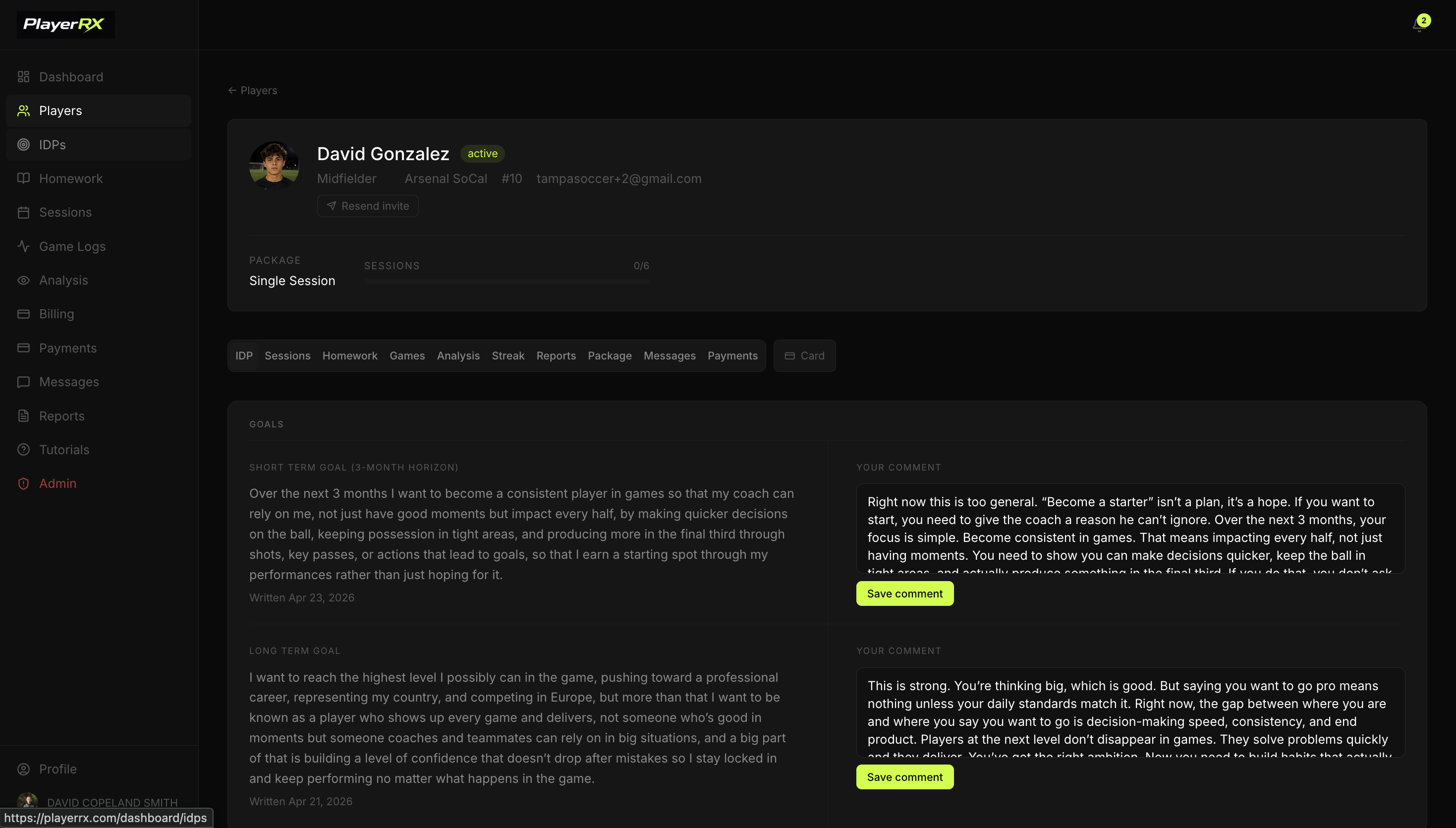
Every player in the club on a written plan. Not just the showcase team.
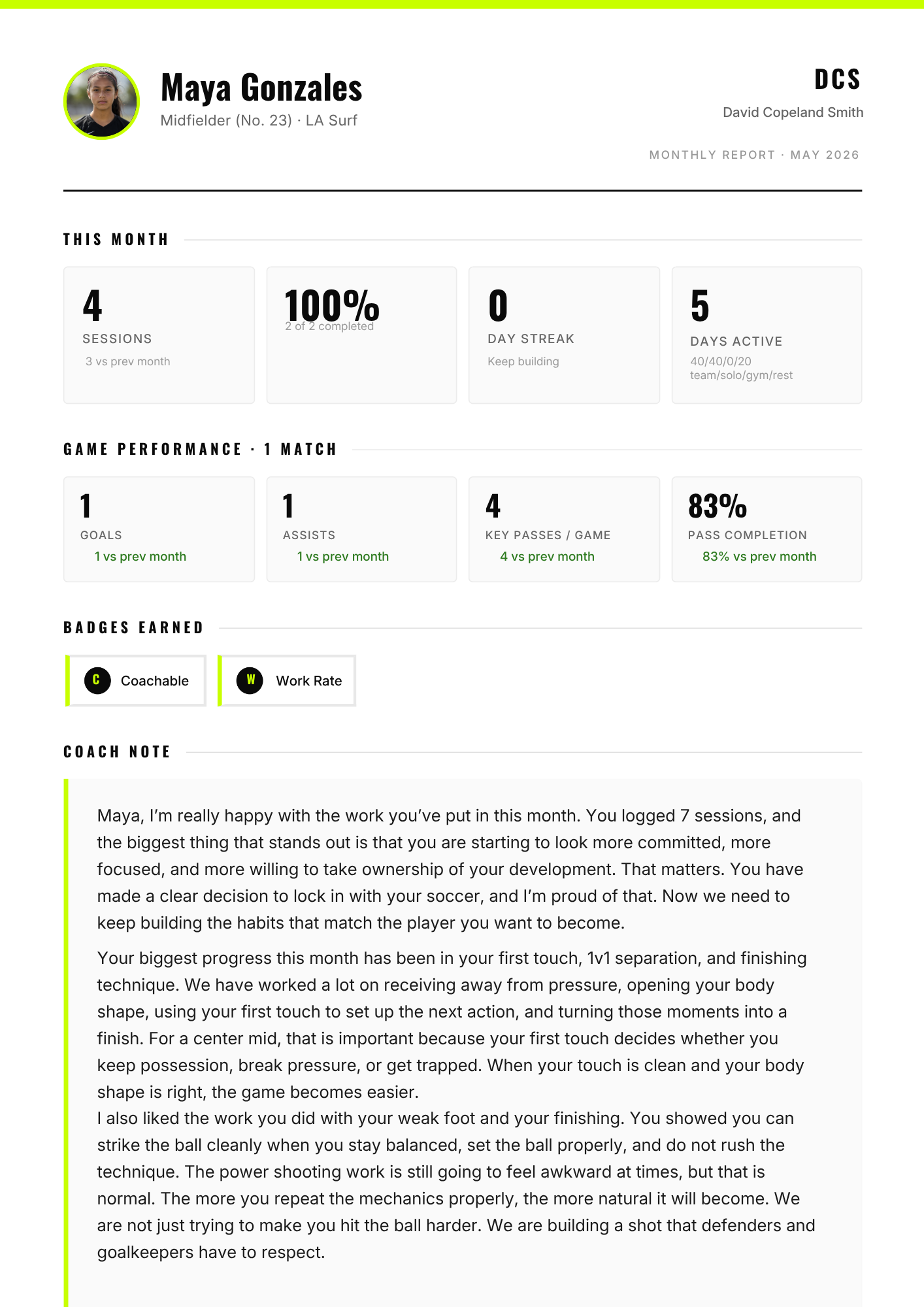
The renewal conversation, answered monthly instead of annually.
No player billing. No player messaging. Your communication and safeguarding policies stay exactly as they are. This sits alongside your admin stack, doing the one job it was never built for.
The walkthrough
See the whole club, on screen.
David walks through the club structure end to end: teams, coaches, a player's IDP, homework, game logs, and the reports that go to your families. Watch it before you fill in anything. This is the demo.
The math
Losing families is the most expensive thing your club does.
Run your own numbers. Say fees average $3,000 a player. Every year a slice of your turnover is families who left because nobody could show them their kid was being developed. Five of those families is $15,000 walking out the door annually, telling other families why.
PlayerRX for a ten-team club is $2,398.80 a year. It doesn't need to move retention much to pay for itself twelve times over.
And that's before the other side of the ledger: when a prospective family tours two clubs and one of them opens an app and shows what every player is working on, which club wins the $3,000?
Next August
Next season's parent meeting.
Preseason parent night, the whole club in the gym. You get up and you don't talk philosophy this year.
“Every player in this club has an individual development plan they helped write. Your kid can show it to you on their phone tonight. You'll get a progress report every month. If you ever want to know what this club is doing for your kid specifically, the answer is written down.”
Then in March, renewal week is quiet. Not because nobody has questions. Because the answer to the only question that matters is sitting in every family's pocket already.
Someone in your market is going to be the first club that can prove development. The only question on this page is whether it's you.
What every director asks first.
“We already use PlayMetrics / TeamSnap / SportsEngine.”
Keep it. Registration, scheduling, payments, comms: solved problems. What your admin stack cannot produce is one document proving your club developed one specific player. That's the layer this adds.
“Our coaches already do IDPs.”
Some do, in five formats with five levels of follow-through, and the records live in their notebooks, which leave when they do. This gives all of it one home the club owns.
“Our coaches will see it as more admin.”
Systems that demand essays die. Here players write their own goals and log their own games; coaches set targets and add notes to work they already do. And your coaches get something real back: their development work becomes visible upward for the first time.
“We don't want forty coaches editing everything.”
They can't. Role-based access: coaches touch their teams only, assistants read-only, structure controlled from the top.
“Parents will expect too much.”
Parents already expect this. They're comparing you to private trainers who hand their kid a development plan in week one. The expectation exists; the only question is whether your club meets it or their next club does.
“Can players message coaches through it?”
No. No player messaging, no player billing. Your communication and safeguarding policies stay exactly as they are.
Invite-only. On purpose.
Club access isn't self-serve. We set up each club's workspace with you, because a development system only works if the club actually intends to use it. Before any money moves, we have a short conversation: how many teams, which age groups first, who owns the structure. Then you roll it out age group by age group instead of dumping software on forty coaches in one email.
If you want software to tick a box on the parent newsletter, there are cheaper ways to do that. This is for clubs that want development accountability across every team, and are prepared to hold their coaches to it.
Pricing
Per team. Paid annually.
$239.88 per team, per year.
Flat and public. Five teams is $1,199.40 a year. Ten teams is $2,398.80. You can calculate your club's total right now without a discovery call, which tells you something about how the rest of this relationship works. Pilot with two or three teams if you want.
Request Club Access.
Tell us about your club, how many teams you want on the platform, and we'll set up your workspace.
The form goes straight to David. Not a sales team. The person who built the system builds your workspace.