PlayerRX for Teams
One team. Every player tracked.
You know your best eleven. Can you say what your other twelve are working on this month? PlayerRX gives every player on your roster a written development plan, homework, game logs, and a record that builds all season. Not just the ones who start.
01 · The car park
“What's your plan for Maya?”
Wednesday night. Session's done, you're carrying cones to the car, and Maya's mum is waiting by the boot of her SUV.
“Can I ask you something? What's the plan for Maya? She's been here two years and I honestly couldn't tell you what she's working on.”
You have a plan for the team. A formation, a training block, a game on Saturday. You do not have a plan for Maya. Not one you could show anyone. So you talk about her attitude, her effort, how she's “coming along,” and you both know you're improvising.
Here's what you don't see. Maya's mum has this conversation in her head every time she writes the club a check. And the private trainer her friend recommended answered the same question in thirty seconds, with a phone screen.
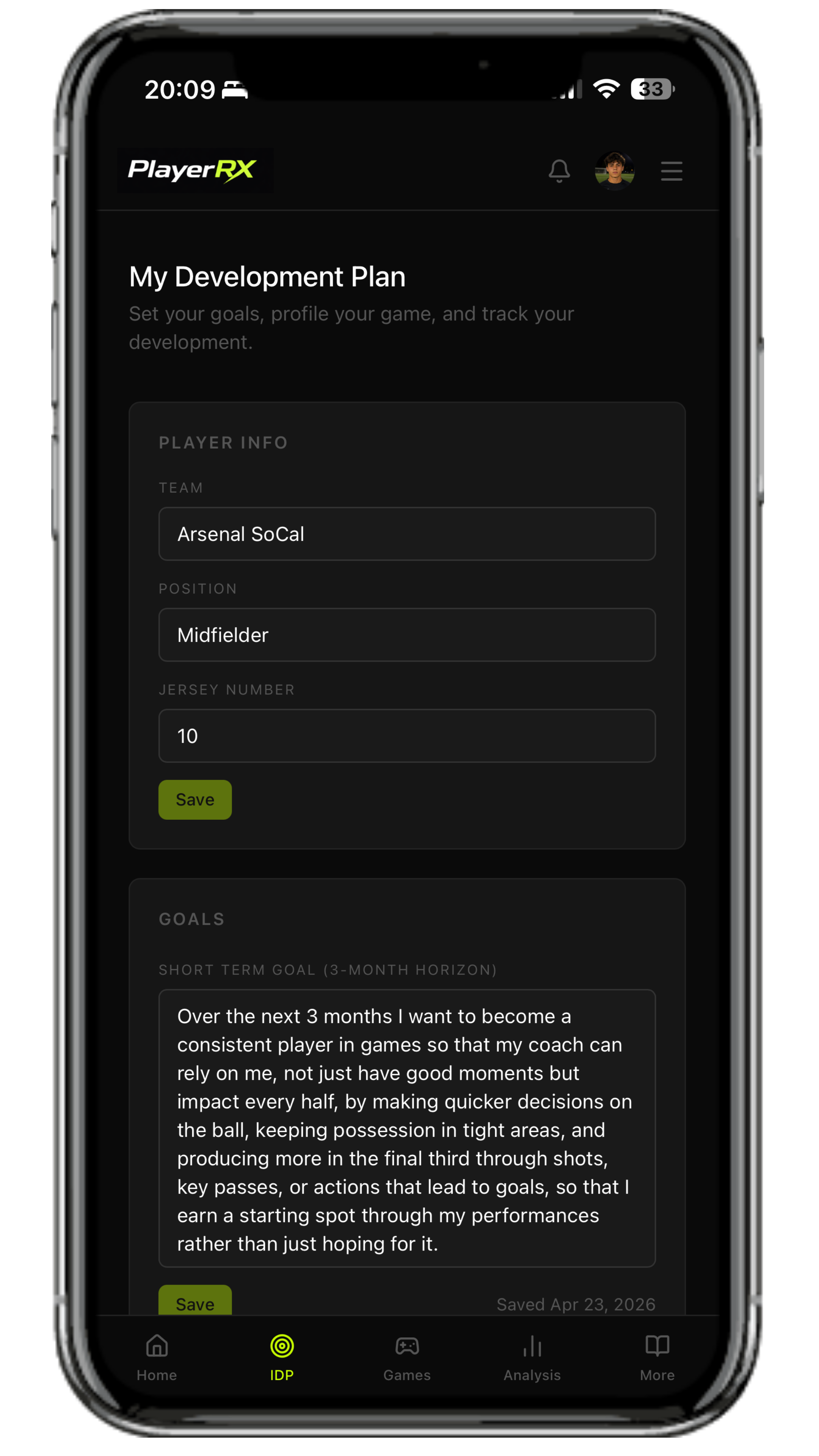
This is the thirty-second answer.
02 · The bench
His parents pay the same fees as the starters' parents.
Every roster has him. Trains twice a week, never misses, plays the last fifteen when the game's already decided.
His development conversation this season so far: nothing. Not because you don't care. Because the fixture list ate the season and the loud problems got the attention.
When his family leaves in spring, and the ones who feel invisible always leave in spring, it won't be a soccer decision. It'll be a “nobody here sees my kid” decision.
The kid who plays fifteen minutes doesn't need more minutes to stay. He needs a plan with his name on it, homework this week, and proof someone is tracking whether he's getting better.
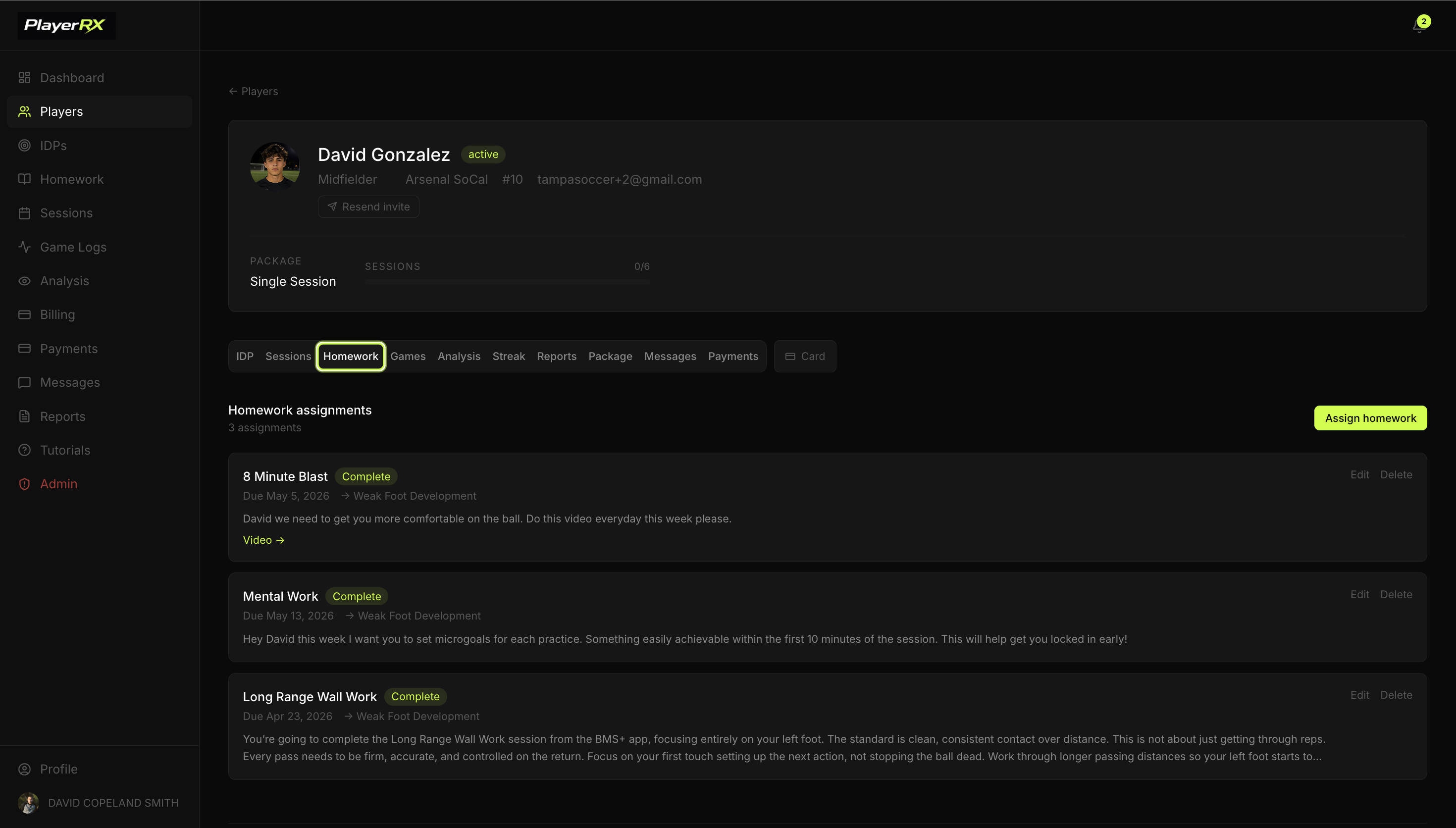
Every player has work on. Including the ones not starting Saturday.
03 · The preseason goals document
You did the IDP thing. It's dead by October.
Be honest about last season. You sat with every player in preseason. Set goals. Maybe built a spreadsheet, maybe a stack of PDFs. Proper intentions.
When did anyone last open it?
That's not a commitment problem. Fixtures, selection, parents, club expectations: team environments squeeze individual development out every single time. A document can't survive that. It has no homework attached, no games flowing into it, nothing pulling the player back to it. It was paperwork with ambition.
A PlayerRX IDP is connected. The player's target areas feed homework. Games get logged against those targets. The record moves every week, whether the season is going well or not.
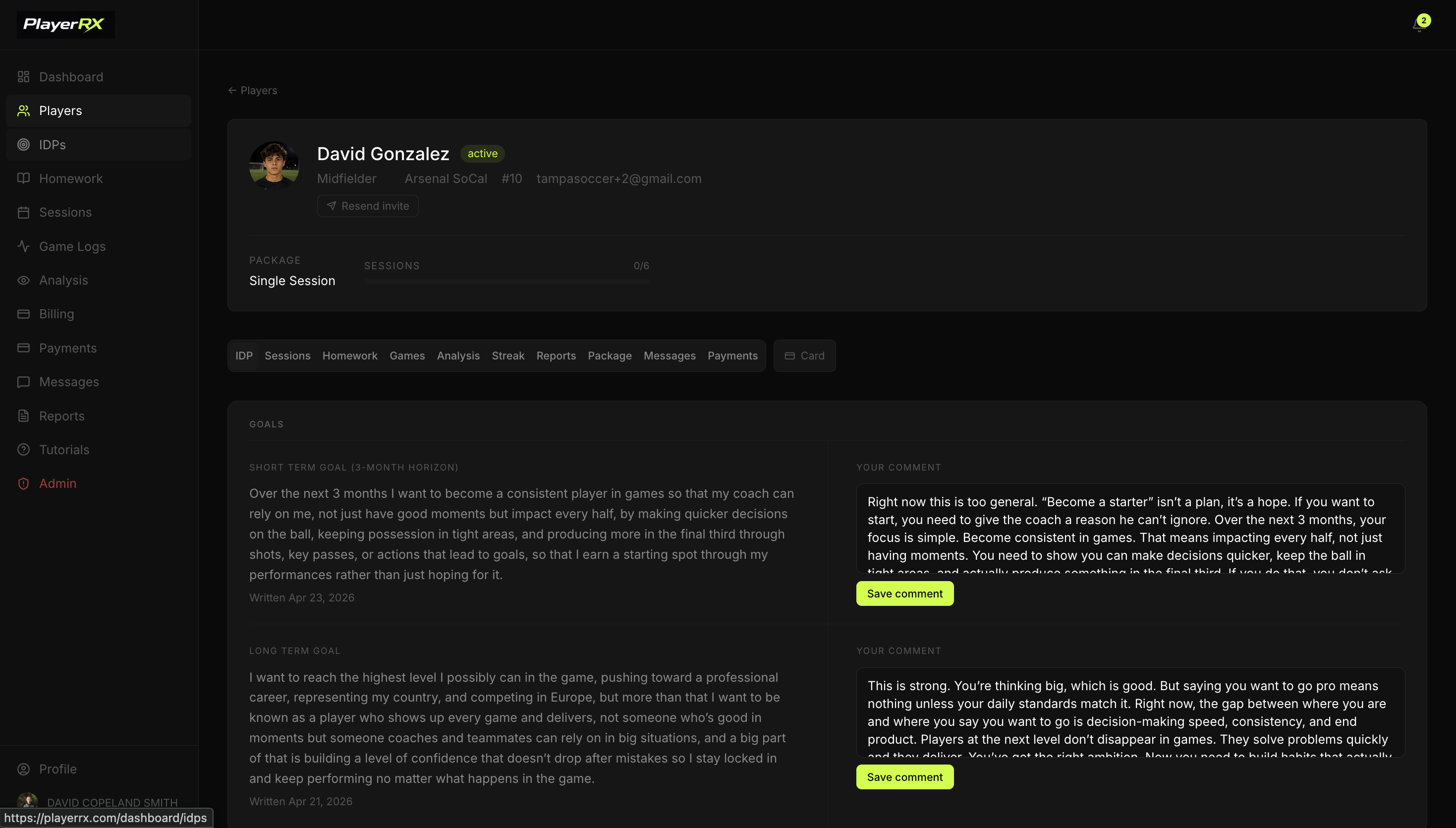
The plan from August, still moving in March.
The system, on screen.
Not a scheduling app with goals bolted on. This is the system serious private trainers charge $120 a session to run, built to work across a whole roster:
Individual Development Plan
Players write their own goals, strengths, weaknesses, and the pros they model their game on. You build the target areas underneath, with measurement criteria and dated notes. The player owns the ambition. You own the plan. Both of you can see it.
Game logs
Players log their own matches: minutes, stats, shot map, and a self-rating against the target areas you set. Saturday's game reaches you before Sunday's coffee.
Homework
Work assigned between sessions with video links attached, sitting in the player's own app, marked off when done. The five days you don't see them stop being empty.
Monthly progress reports
What moved, what didn't, what's next, pulled from the season's actual data plus your notes. The parent conversation goes from car park ambush to document you're proud to send.
Session summaries
What the team worked on and what it was for. A record that builds week after week.
Assistant coach access
Read-only. Same records, same message to the player, no uncontrolled editing.
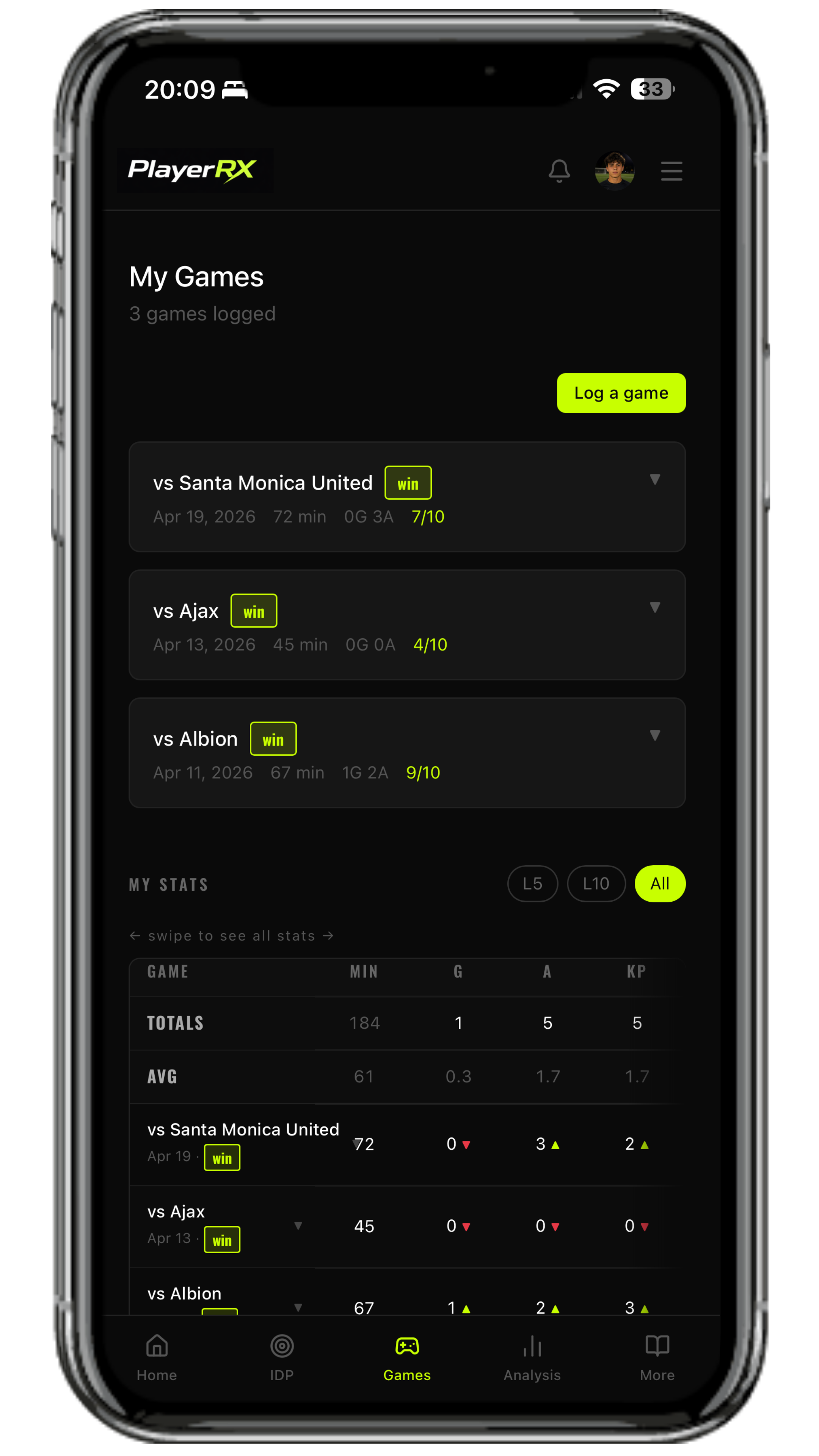
The car ride home, replaced with actual data.
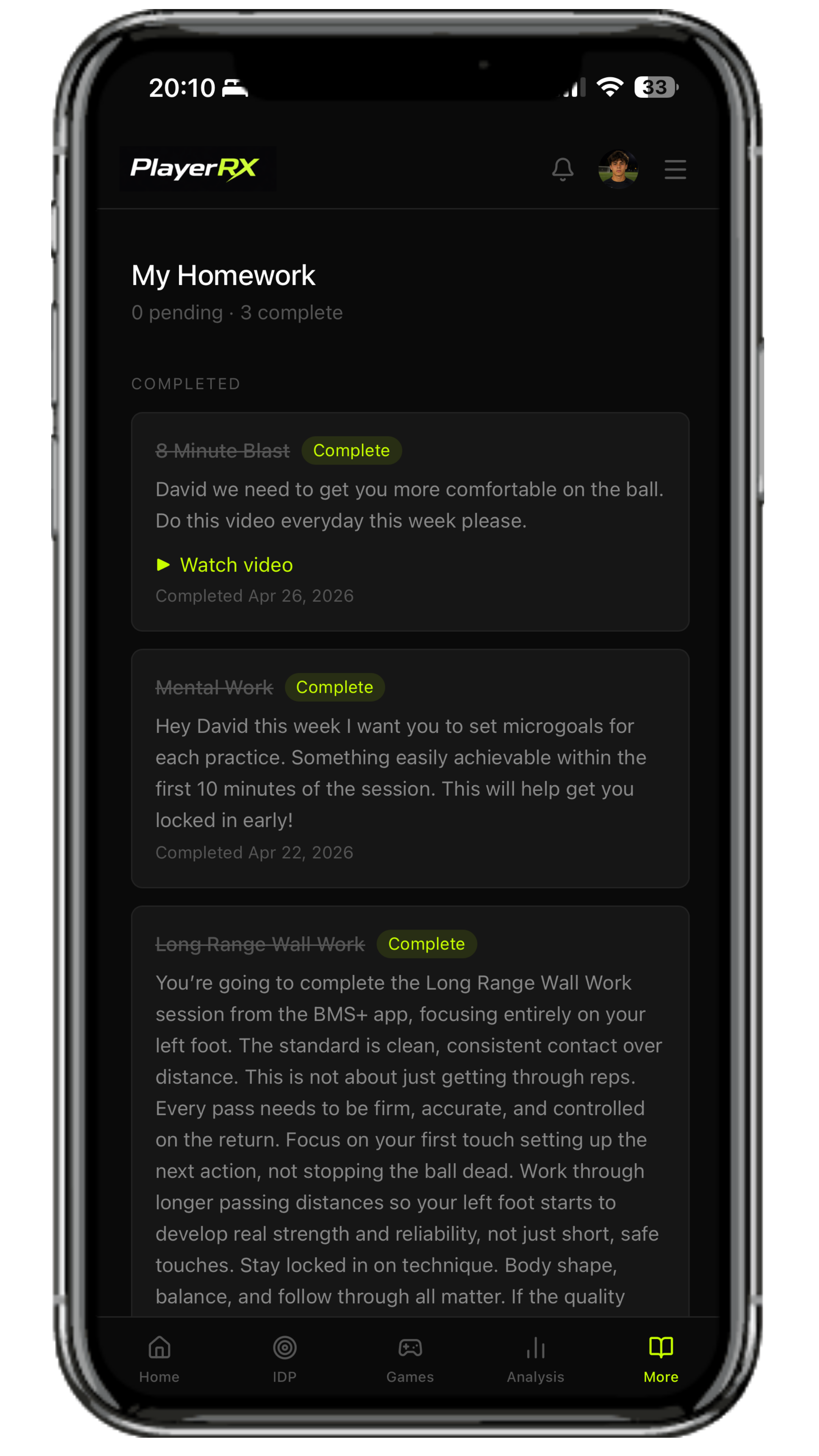
Homework in their pocket, not in a group chat.
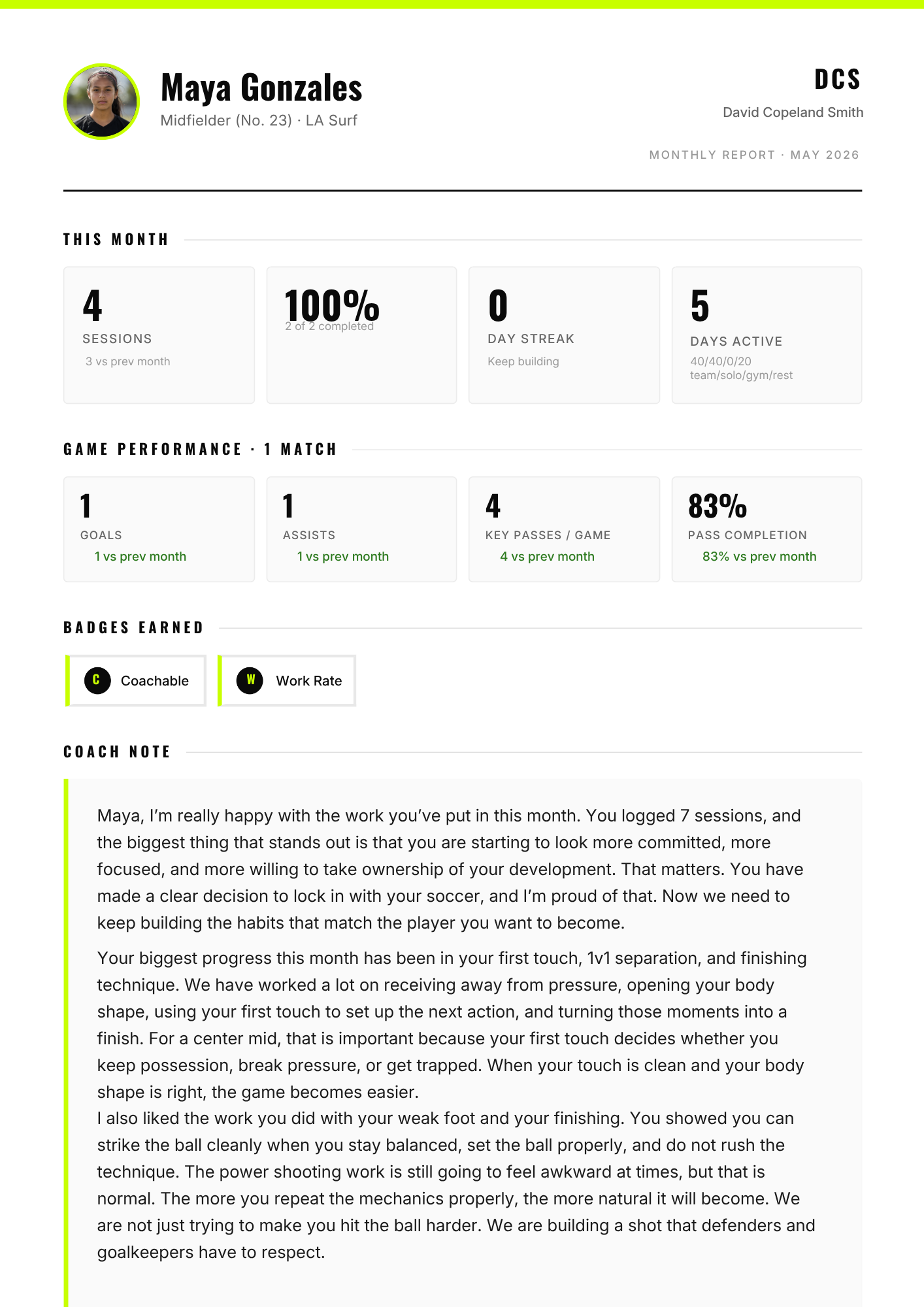
“How's she doing?” answered properly, once a month.
No player billing. No player messaging. Keep TeamSnap for the logistics. This is the development layer.
The walkthrough
Watch it run.
David walks through the whole system: the team, a player's IDP, homework, game logs, and the reports your parents will actually read. No demo call to book. This is the demo.
The math
What one leaving family costs.
Club fees where you are run somewhere between $1,500 and $4,000 a player. Take the low end. One bench player's family stops believing and walks in spring: $1,500 gone, plus the two families they talk to on the sideline every Saturday. Call it what it usually becomes: $4,500 and a reputation dent in your age group.
PlayerRX for your whole team is $239.88 a year. Sixty-six cents a day for a written plan on every player you coach.
You don't need it to save a family every season for the math to work. You need it to save one family once every six years. It will do considerably better than that, because the families most likely to leave are precisely the ones a visible plan retains.
Next season
End-of-season meetings, next year.
Old version: you reconstruct nine months from memory, lean on the loudest moments, and say “coming along” eleven times in one evening.
New version: you open the player's record. Here's what she was working on in September. Here's the homework she completed, and the homework she didn't. Here are her sixteen logged games and what trended. Here's what next season's plan starts with. Fifteen minutes per family, and every one of them leaves knowing their kid was seen.
Then the DOC asks how you're getting glowing parent feedback in a season where you finished mid-table. You show them the system. That conversation has never once hurt a coach's career.
What every coach asks first.
“We already use TeamSnap / PlayMetrics.”
Keep it. Those manage schedules and availability. Neither can tell you what your left back is working on this month. Different layer, different job.
“I don't have time for IDPs for 24 players.”
The players do most of the writing: their goals, their strengths, their game logs. You build target areas and add notes to work you're already doing. Minutes a week, not a second job.
“We already set goals in preseason.”
And where are they now? Writing goals was never the problem. Keeping them alive past the third fixture is. That's why this connects goals to homework, games, and reports.
“Can players message me through it?”
No, by design. No player messaging, no player billing. It's a development record, not another chat channel to manage.
“Will my club pay for it?”
It's $239.88. Most teams spend more on tournament snacks. Plenty of coaches cover it from the team budget and let the results argue.
Pricing
Per team. Paid annually.
$239.88 per year. Up to 30 players.
Less than one private session costs, for a full year of documented development across your entire roster.
Request Team Access.
Tell us about your team. You are not entering a sales funnel. The form goes straight to David, and setup usually starts within a day.
No demo call required unless you want one. No onboarding fee. Payment only happens when your workspace is set up and you are ready.