You have the plan.
They need to see it.
The methodology lives in your head. The target areas. The mirror players. The signature moves. The ninety-day reviews. Every player you've ever developed had one. Until now it's been invisible to everyone but you.
$19.99/month. Cancel any time. No long contracts.
A mum asks what her daughter is working on.
Two months in. You answer in detail, top of your mind. Her first touch. The angle of her standing leg. The runs you've started introducing in tight space. The weak-foot finishing you'll bring in next month.
You speak for ninety seconds. The mum listens. She smiles. She nods.
She believes you. She has nothing to read.
She believes you. For now.
Every parent paying for development is running the same quiet calculation. Is my player actually getting better. Is what this coach says he's doing actually happening. Is there a plan, or is he winging it for $120 an hour.
Most of them never tell you what they decided.
The ones who stop believing just stop booking.
It's not your methodology. It's that nobody can see it.
You have a plan for her. You know what she's working on. You know what comes next. You know what she's strong at and what's holding her back. You know the pro she should be watching and the moves she should be stealing.
All of it lives in your head.
The mum can't read it. Her daughter can't read it. The parents you'd like to sign next month can't read it.
When a coach says 'this is my methodology' and can't show it, the methodology doesn't exist for anyone but them.
A serious development coach puts the plan in writing.
Once a week. Or every day.
where the work happens
where the habit lives
You see your player once or twice a week. That's where the training happens.
The other five days, the player is on their own. If your methodology lives in your head, those days are empty.
PlayerRX gives the player something to come back to between sessions. The homework you set on Tuesday sits in their app waiting to be marked off. The daily streak ticks every time they show up. Rest days count. The game they played on Saturday gets logged the same day, while it's still fresh, with stats trending against the target areas you set.
A document doesn't create a habit. The streak, the homework, and the game log do. The plan in their pocket is what the streak runs on top of.
You just signed a new player.
Twelve years old. Plays right back. Wants the academy team next September.
A year ago this is where the work would have leaked. Drive home. Scribble half an IDP into a Notes file. Forget where you put it. Tell yourself you'd finish it next week.
Tonight you don't lose anything.
You open PlayerRX. Add the player. Position. Package. The platform sends him an invite while you're still at the table.
By the time you've eaten, he's already in the app. He's written his own short-term goal: starting position at right back by November. Long-term: academy invite next September. He's listed Trent for distribution and Reece James for body shape as the pros he wants to model. He's written his own strengths. His own weaknesses, in his own words.
That's the work the player should be doing. Coach can't write a player's ambition for him. Now you don't have to.
Wednesday morning you open the platform and read what he wrote. You build the three target areas underneath: weak-foot crossing reps, half-volley distribution under pressure, communication patterns in the back four. Each one with measurement criteria. Each one with a homework drill attached and a video link.
By Wednesday's session you both walk onto the pitch knowing exactly what you're working on. That used to take you three sessions and a coffee with the parents. The platform did it before the first ball was kicked.
The methodology, in writing.
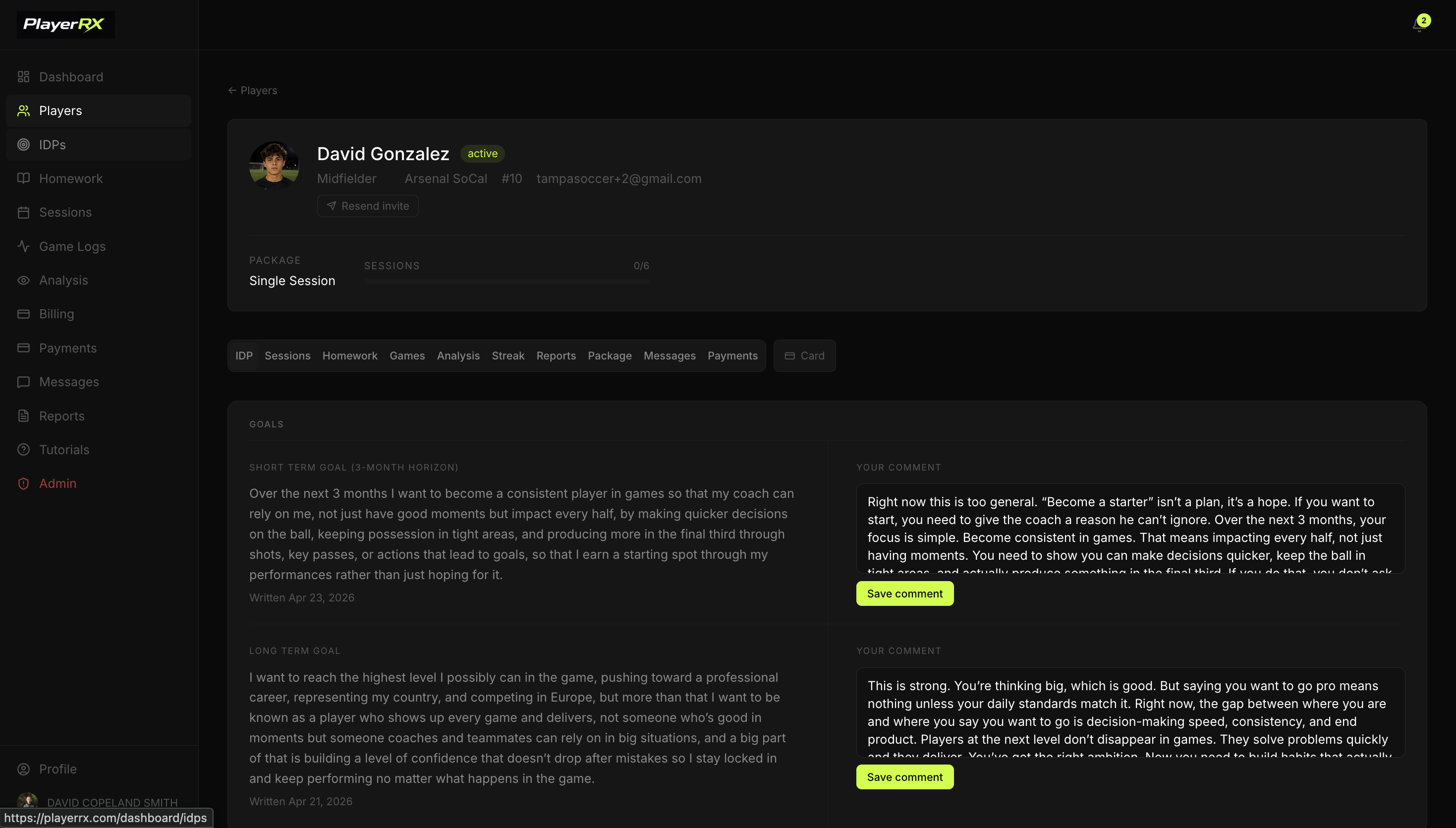
Every player has a development plan, written between the two of you. The player owns the short-term goal, long-term goal, strengths, weaknesses, and mirror players. The work only they can honestly do. You own the target areas underneath, with measurement criteria and dated coach notes. Ninety-day review built in. The methodology that used to live in your head is now in writing, on their phone, in their pocket. Evidence-based individual plans, built from goals, sessions, homework, game logs, and progress data, not memory. One click turns the live IDP into a branded PDF: goals, target areas, player card, radar profile, and development priorities in one document to hand to the parent after a session.
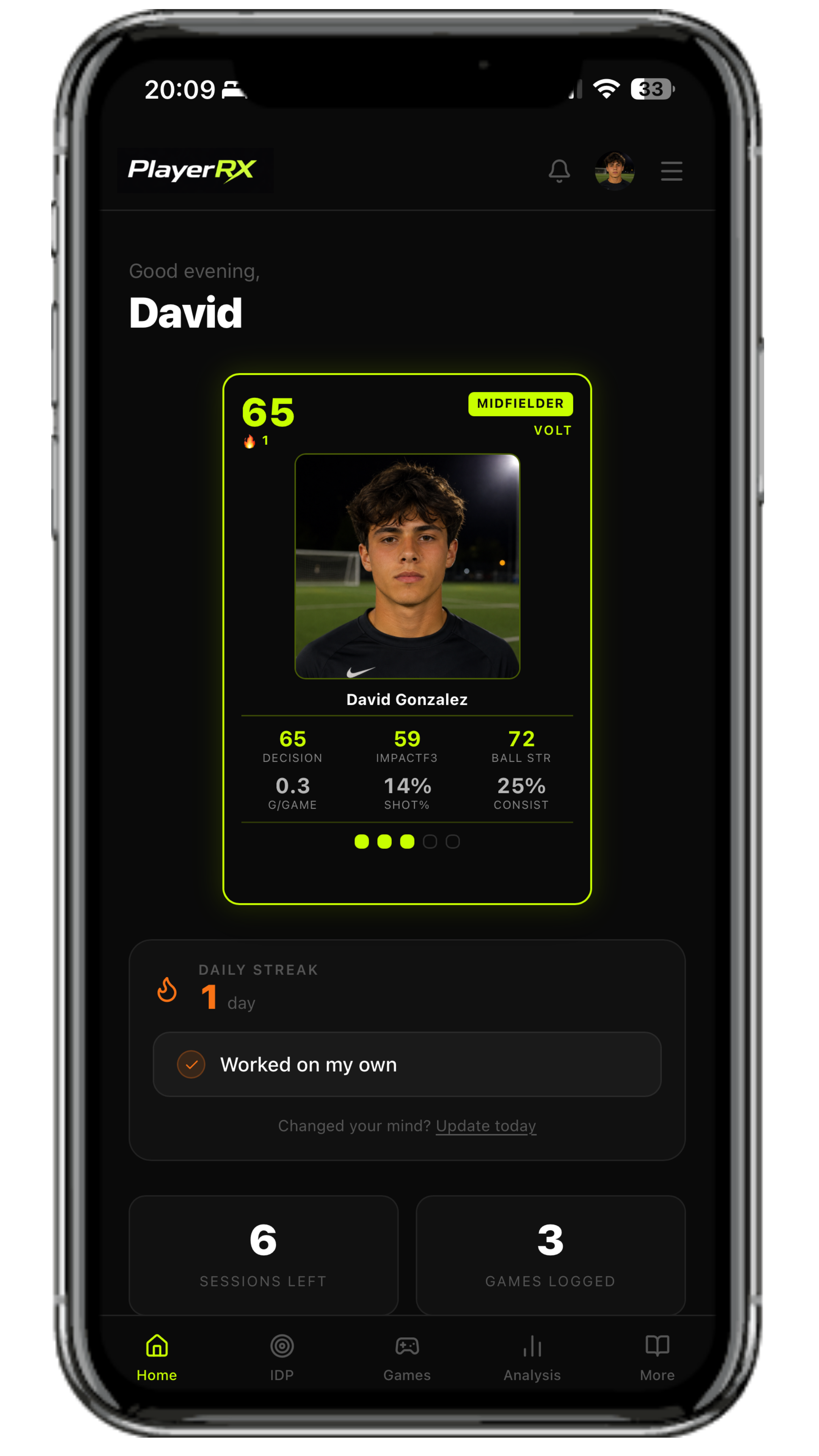
The PlayerCard. Rating, position, target-area stats. The kind of thing your player wants to screenshot for their Instagram story. Badges fire when they do real work. Sessions completed. Homework done. Games logged. The streak ticks every day they show up.
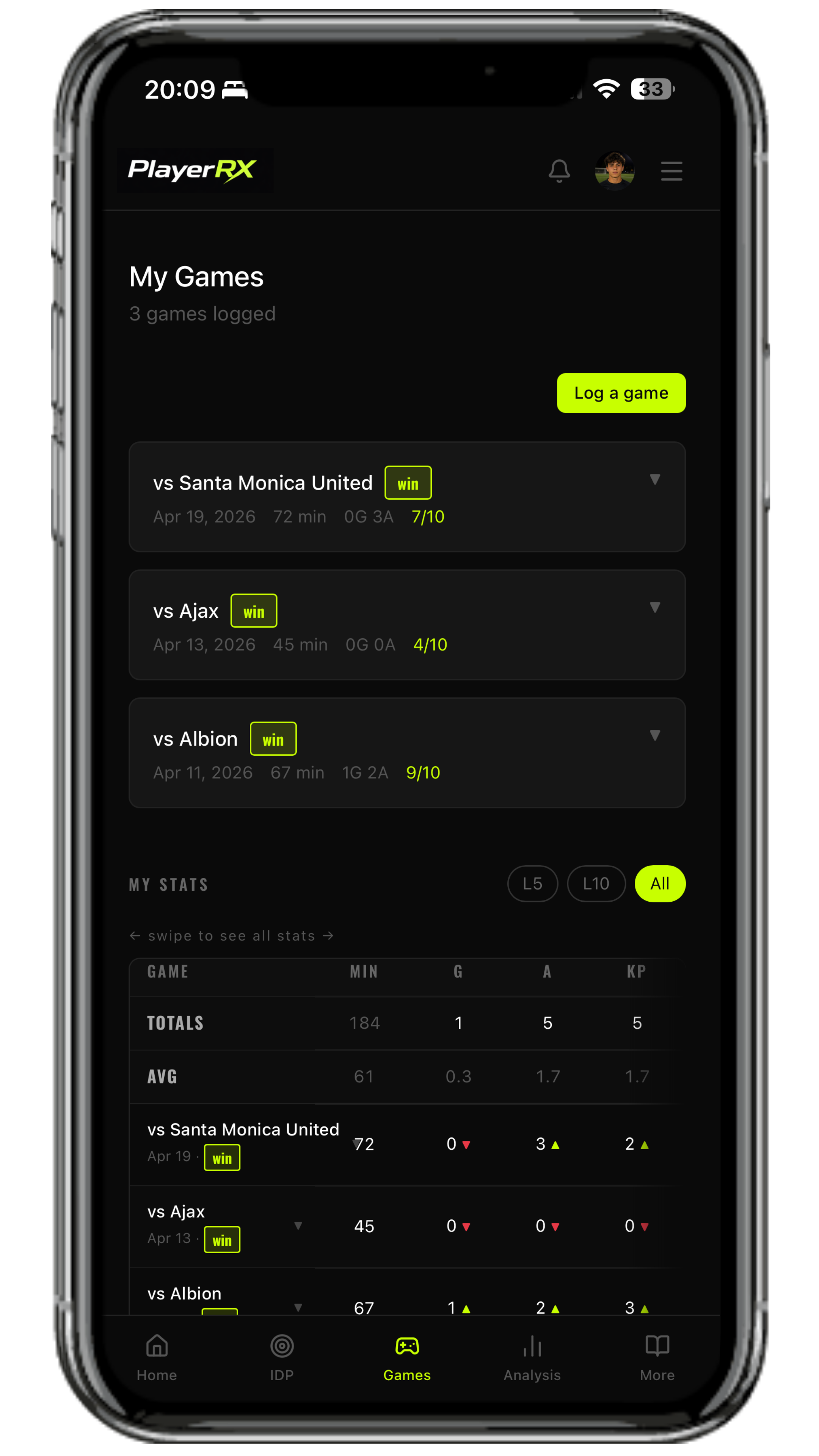
Player game log. Players log their own matches. Self-rate against the target areas you set. The data goes back to you before you've had coffee.
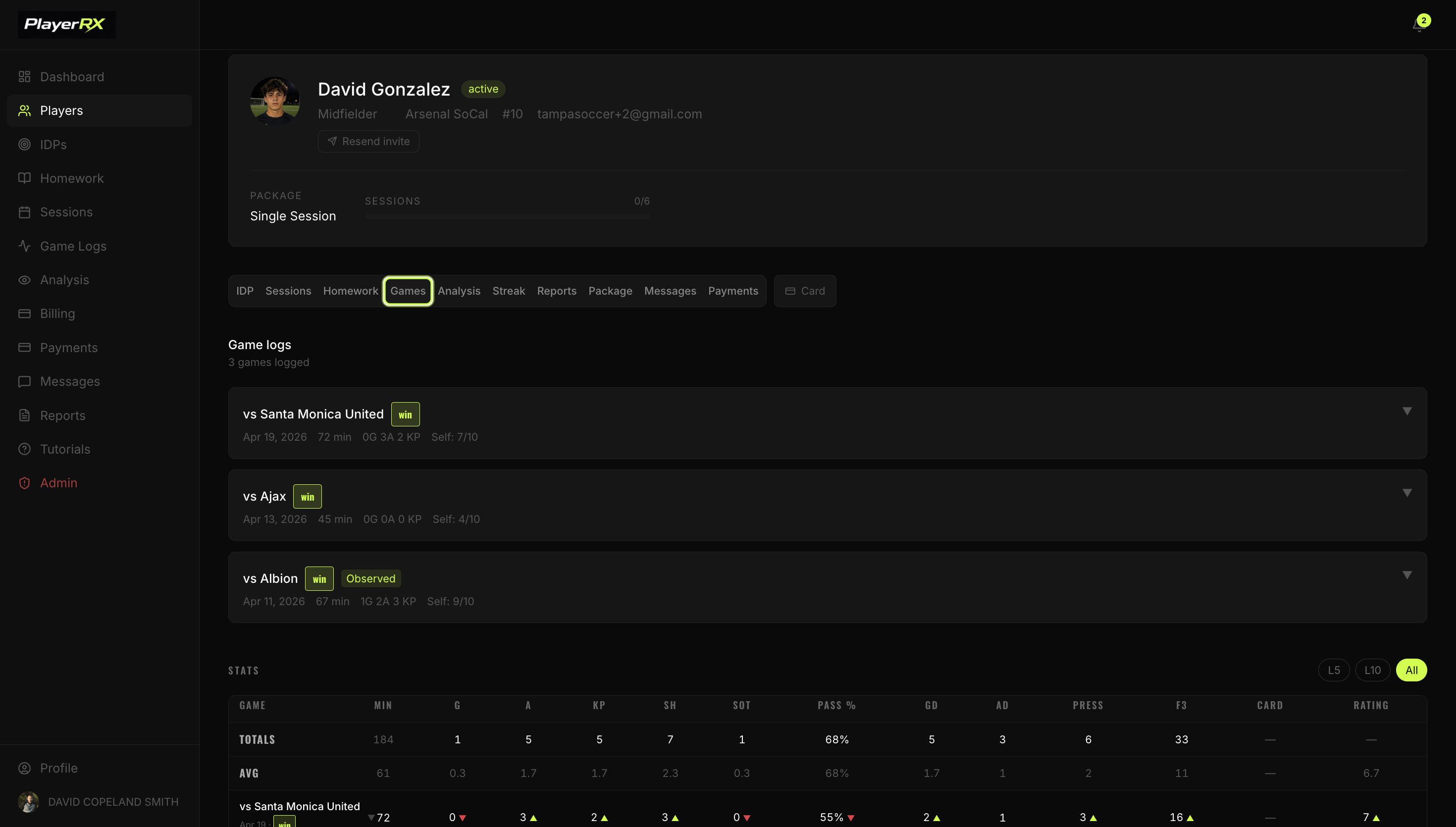
Trainer view. Every match logged. Shot positions in the final third. Stats trending against the IDP, not just the season average. The plan stops being theoretical.
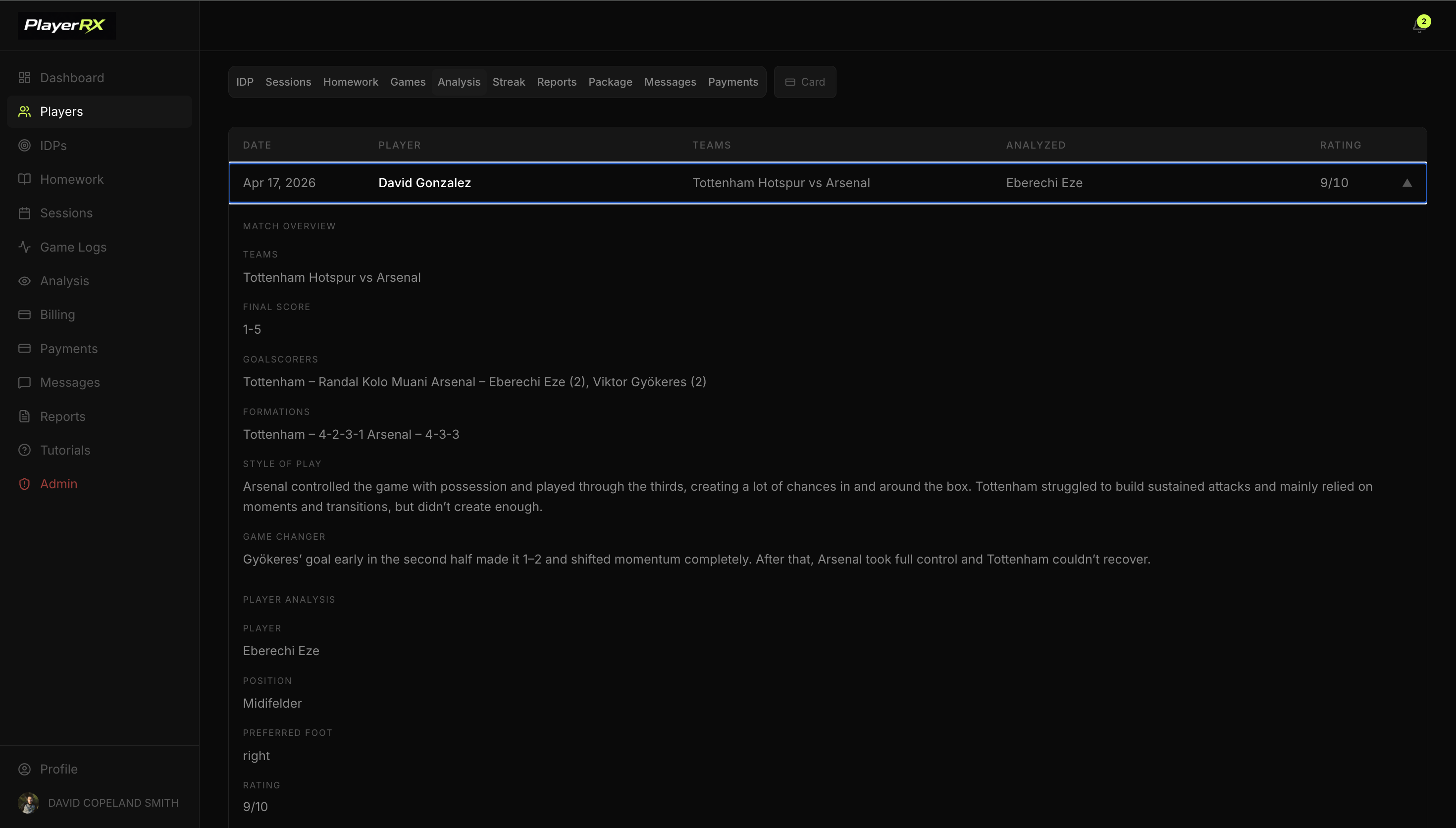
Pro game analysis. The framework David uses with pros, now built into every player's profile. Match overview, formations, key moments. A deep breakdown of the pro your client should be studying: position, foot, rating, impact, strengths, weaknesses. What specifically to take from their game. Shot data and build-up patterns mapped. No other tool in this space touches this work. It's been the unfair advantage at Beast Mode Soccer for twenty years. Now it ships with every player you train.
What invisibility costs you.
She doesn't tell you. She just stops booking. That family was $120 a session, once a week, forty weeks a year. $4,800 out the door. Quietly.
You know you should be charging $120, not $100. You can't justify it without something to show. Twenty players a week. Forty-five weeks a year. That's $18,000 you left on the table.
Two prospective clients this year. They chose the trainer down the road because his players had a development plan and yours didn't. $9,600 you didn't get to compete for.
Development is invisible work. The trainers who win make theirs visible.
Pricing
Up to 20 players. $2/player above that. Every feature included.
Stripe Connect transactions: 1.5% PlayerRX fee in addition to Stripe's standard 2.9% + 30¢ processing. Or use cash. The platform doesn't force anything.
Cancel any time. No long contracts. Paid from day one because the product is finished.
Now for trainers, teams, and clubs
The same development standard. Three ways to run it.
The original PlayerRX. Every client on a written IDP, with homework, session history, game logs, and monthly reports. The plan in their pocket, the proof in yours.
$19.99/month. Cancel any time.PlayerRX for Trainers →Put your whole roster on the system. Every player gets an IDP, homework, session notes, game logs, and a development record that builds all season.
$19.99/month per team, paid annually.PlayerRX for Teams →Create teams, assign coaches, and keep IDPs, session notes, and reports consistent across the whole club. Invite-only, for clubs serious about development accountability.
$19.99/month per team, paid annually.PlayerRX for Clubs →There are developers. And there are social media trainers.
Two kinds operating in your market right now.
The social media trainer. Follower count. Viral clips. Reel edits. The session looks sharp on camera. Whether the player is actually developing is a different question.
The developer. The one who builds a plan with the player on day one. Who can sit with a parent and show them exactly what the next ninety days look like. Who can answer 'how's my player developing?' with a document, not a verbal summary. Who can pull up six months of progress without thinking about it.
The developer justifies $150 an hour. Not because they shout about it. Because the development is on the record and the results are provable.
You already know which trainers in your market are which.
The work doesn't sell itself. The documentation of the work sells the work.
Your operation. Twelve months from now.
It's May. You're sitting at home on a Sunday. Twenty-six players on the books. Every one of them has a written IDP. Every one of them knows what they're working on. Every one of their parents can see the plan, the progress, and the next ninety-day review on their phone.
You raised your rate to $120 in November and nobody flinched. They could see the work.
A new family signed up last week. Inside an hour, their daughter had a development plan in her hand. That used to take you three sessions and a coffee with the mum. Now the platform does it before the first ball is kicked.
Tomorrow morning you have four sessions. You know which player is working on what before they show up. The IDP is in the platform. The homework you set last Tuesday has been completed and logged.
You coach. You log. You go home.
That's the operation.
Parents are running out of patience for invisible coaches.
Five years ago, 'trust me, I'm working on it' was enough.
It isn't anymore.
Parents are paying $5,000 to $20,000 a year per kid in this market. They're comparing what your operation looks like to the trainer down the road. The one whose players can pull up their IDP on their phone in the car after a session. The one whose parents get a monthly development report instead of a text update.
You get to be the visible coach. Or you get to keep being the invisible one while the visible ones take your families.
Every month you stay invisible is a month a visible competitor is winning the parents you should be winning.

Why I built PlayerRX.
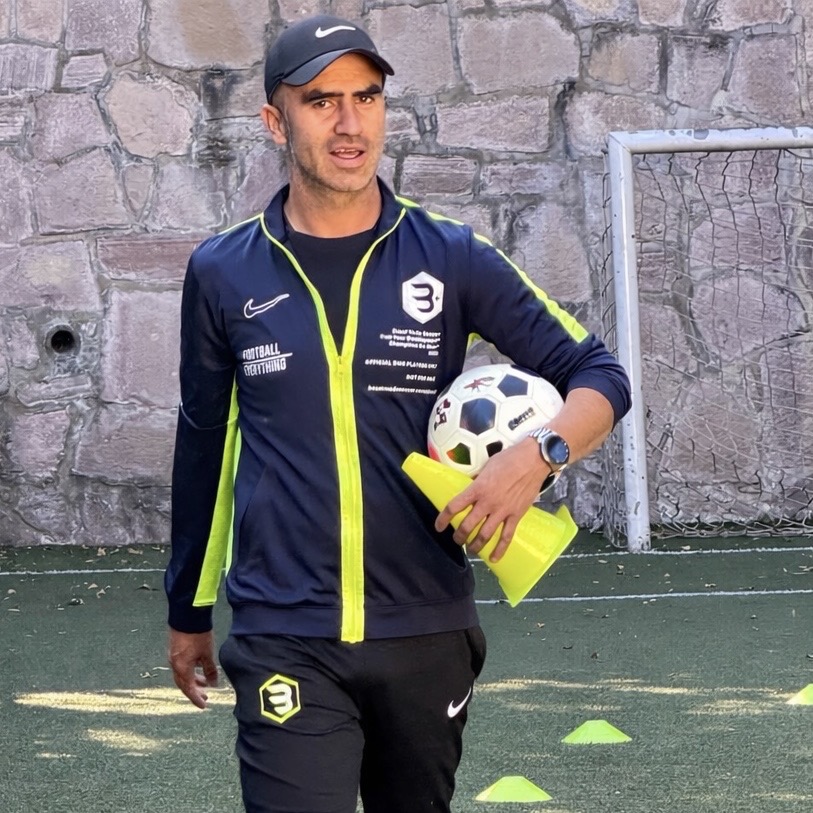
Six in the morning, Los Angeles. Twenty-two years on training pitches. Twelve years with Alex Morgan. Guiding Rachel Daly from college through winning the Euros and a World Cup final. Sessions with Kelley O'Hara before a World Cup. Eight years with Tobin Heath. Tyler Bindon, worked with him since he was a young player, preparing him for his Premier League career and World Cup 2026 with New Zealand.
Every one of those relationships lasted years because the development plan was real. Target areas we kept refining. Mirror players we'd study together. Signature moves we worked into the game. Ninety-day reviews where we'd stop and look at what had moved and what hadn't.
For twenty-two years I ran that methodology out of my head and a folder of Word documents.
I knew exactly what private coaching needed. The thing the parents were paying for was the development plan. The thing nobody could see was the development plan.
So I built it. Hired the engineers who could ship to the standard the work needed. Gave them the blueprint, the language, the workflow. Every part of PlayerRX came from a problem I was solving with a real player. The IDPs. The target areas. The mirror players. The signature moves. The pro game analyses. The ninety-day reviews.
If you're serious about development, this is what your operation should look like.
Beta trainers
The first trainers on the platform.
I've tried to manage players through notes, WhatsApp, spreadsheets… it always turns into a mess. PlayerRX fixed that immediately. Everything is in one place. I can see what each player is working on, track their sessions, and actually hold them accountable without chasing them. The biggest thing for me is structure. Before, I had ideas. Now I have a system. It's made me a better coach because I'm not guessing anymore.

What stood out to me straight away was how simple it is to use but how much control you actually have. I can assign work, track it, and go back and see exactly what's been done. That never existed for me before. Players also take it more seriously because they can see their progress. It's not just training anymore, it feels like a professional setup. For me, that's the difference.
FAQ
What every serious trainer asks before they start.
What if my methodology isn't written down yet?
My players are young. Are they actually going to engage with their IDP?
I'm not technical. Is this going to be hard to use?
I only train ten players. Do I need this?
What about Veo or Trace?
What about the parents who still pay me in cash?
Is there a free trial?
My data, my players. What happens if I cancel?
There are two kinds of trainers right now.
The ones whose methodology lives in their head, hoping the parents take their word for it. And the ones running PlayerRX, putting the development plan in the player's hand on day one.
You already know which one you want to be. You wouldn't have read this far if you didn't.
$19.99 a month. Cancel any time. Start now.